Trying to Become an OpenClaw Contributor: Five Attempts, One Decision Gate
In mid-2026 I spent several weeks trying to land a first merge into OpenClaw — the self-hosted multi-channel AI gateway people jokingly call the “lobster.” I wanted a real code contribution, not a docs-only drive-by.
I did not get that merge. I did get a clearer picture of how a high-throughput, bot-heavy OSS project actually absorbs (or deflects) outsider patches, plus a short personal reply from Peter Steinberger on the first PR. This post walks through five attempts, how AI helped across the whole loop, and why the last PR stalled on a product decision rather than missing tests.
How I worked (with AI)
OpenClaw’s issue tracker moves fast — thousands of open items, heavy labeling, and an automated reviewer called ClawSweeper. Searching by hand is noisy. I leaned on an AI coding agent for more than triage.
My workflow was roughly:
- Sync my fork to
openclaw/openclawmain. - Ask the agent to scan labeled issues (
queueable-fix,fix-shape-clear,source-repro, avoidlinked-pr-open/no-new-fix-pr) — this is the “review vulnerabilities / find fixable defects” step, not a security exploit hunt. - Filter for bugs I could reproduce on Windows with unit tests or a small Control UI check.
- Prefer narrow owner boundaries (one helper, one UI index, one dependency list) over cross-process policy rewrites.
- Have the agent draft the patch, add tests, and run the focused Vitest shards; I steered the goal, checked the diff, and decided when to open, rewrite, or close a PR.
So the honest version is: AI did most of the mechanical engineering. I did the judgment calls — which bug to chase, when a review loop had grown past a first contribution, and when to walk away.
Five attempts on a timeline
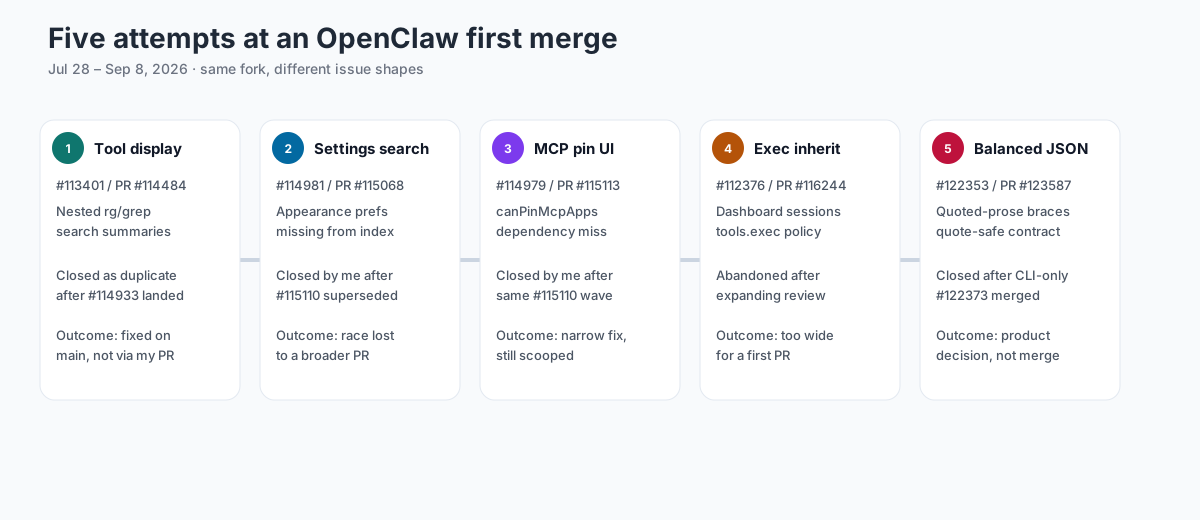
1) Nested rg/grep search summaries — #113401 / PR #114484
Bug. Exec tool display wrapped an already-summarized pattern again, producing nested text like search "search \"…\" in …" in ..
Fix. Reject unsafe patterns (already a summary, backticks, newlines, overlong) and fall back to search text.
Result. Closed as a duplicate after maintainer PR #114933 landed the same class of fix. Peter (steipete) left a short reply thanking the overlapping contributors and superseding several PRs, including mine. The bug was fixed on main; my PR was not the merge vehicle.
2) Settings search missing Appearance controls — #114981 / PR #115068
Bug. Queries like session observer / camera / dictation / message width returned nothing, even though the controls already existed under Appearance.
Fix. Index those sidebar/chat preference keywords in the settings-search catalog and deep-link to existing anchors. I also posted a small unmocked runtime proof script for ClawSweeper.
Result. The issue was closed via a broader maintainer PR (#115110). My branch was behind and conflicted; I closed #115068 myself as superseded.
3) MCP pin button not refreshing — #114979 / PR #115113
Bug. Chat thread reactive deps included canPinWidgets but omitted canPinMcpApps, so the pin control could stay stale when capability flipped.
Fix. One-line dependency fix plus a focused UI test.
Result. Same wave as above — scooped by #115110. I closed the PR.
Pattern so far: small UI/display fixes were easy to do, hard to own, because maintainers were also batching related Control UI work.
4) Dashboard tools.exec inheritance — #112376 / PR #116244
Bug. New Dashboard / WebChat sessions could initialize exec as security=deny instead of inheriting configured tools.exec policy.
Why I walked away. Review findings kept expanding across CLI loopback grants, Gateway caches, and moving main. It stopped looking like a first-contribution-sized change. I closed the PR and said so publicly, then looked for something smaller.
5) Quoted prose vs balanced JSON — #122353 / PR #123587
Bug. extractBalancedJsonPrefix selected {/[ before tracking quotes, so a brace inside leading quoted prose (e.g. "notjson{here}") became a fake fragment and hid the later real object.
Fix direction. Quote-aware start scan in packages/normalization-core. That part was straightforward. The hard part was the adjacent malformed-quote contract:
- completed quoted spans must stay skipped (the reported bug);
- unterminated quotes still want recovery on today’s
main(legacy quote-blind behavior); - some inputs are byte-for-byte ambiguous between those goals.
ClawSweeper walked me through several incorrect intermediate heuristics (whole-input fallback, checkpoint backtracking, JSON.parse gates). The version I left documented was the quote-safe rule ClawSweeper itself recommended: never re-enter a completed quoted span; accept null when malformed quoting makes recovery ambiguous.
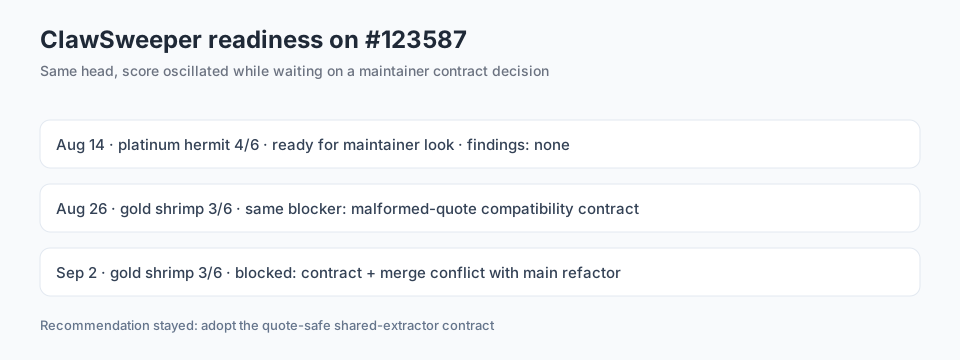
Proof and findings landed in a good place (findings: none, live direct-function output in the PR body). Merge readiness still bounced between gold shrimp and platinum hermit because the remaining gate was maintainer product decision, not missing tests.
Parallel path. A competing CLI-only approach (PR #122373) landed later: restore quote-aware scanning for CLI mixed output, leave the shared helper’s other callers alone. That is a coherent choice; it is just not the shared-extractor contract my PR asked for.
On 2026-09-08 I closed #123587. The branch was also conflicted with a later main refactor, and sitting open mostly generated review-bot noise.
What the wait taught me
Silence usually means queue pressure, not a personal snub. OpenClaw merges a huge volume of PRs. Maintainers were not idle; they were clearing work that can land without a product debate. A P2 that needs an explicit compatibility decision simply sits further back than a patch ClawSweeper can send through on its own.
“Ready for maintainer look” ≠ “about to merge.” For #123587, that label meant author-side blockers cleared. The bot still correctly refused to treat a silent semantic change as done.
Racing maintainers on UI chores is a bad bet. Attempts 1–3 were correct patches that lost ownership races. Attempts 4–5 were strategically different: one too large, one product-gated.
AI can write the patch; proof still has to be visible. My agent drafted code and tests. Exact-head unmocked outputs and green consumer shards were still what ClawSweeper treated as evidence. Without those, the review stalls regardless of who typed the diff.
Fork Actions will email you forever. Upstream schedules (Live/E2E, Stale, PR CI Sweeper) fail on a fork that lacks App secrets. I eventually disabled Actions on the fork entirely after closing the last PR.
Closing note
I still like OpenClaw as an architecture to study. I did not become a merge-listed contributor this round. That is fine. Peter’s short reply on the first PR was a useful reminder that someone had actually looked at the work, even when another commit closed the bug.
If you are aiming at a similar high-velocity repo: pick bugs that are owned by one helper, reproducible without special hardware, and not labeled as waiting on a product decision. And if two strategies exist (shared vs consumer-local), say so early — or you may do the harder correct work and still watch the narrower patch merge first.
Links for the trail: