Trying AI Podcasts: An 11-Minute Take on Andrew Ng
I already listen to a lot of podcasts. I can put one on after I wake up, and another before I sleep — it is the easiest way I have found to use those edges of the day. Almost everything I pick up this way is AI-related, both the technical side and the product side, because that is the direction I am already in. For me, that kind of listening is not something text can replace.
Lately, just by ear, it feels like almost half of what I hear is AI-generated. So I wanted to make one myself, just for fun.
I found ListenHub in the WayToAGI community. The loop is short: paste a YouTube URL, pick two voices, wait. It also produces visual summary cards.
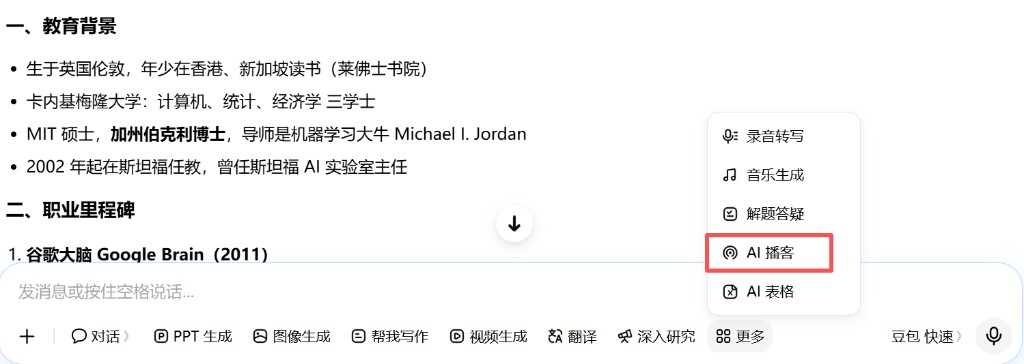
Doubao (豆包) has an AI podcast option under More. It does not take a YouTube URL.
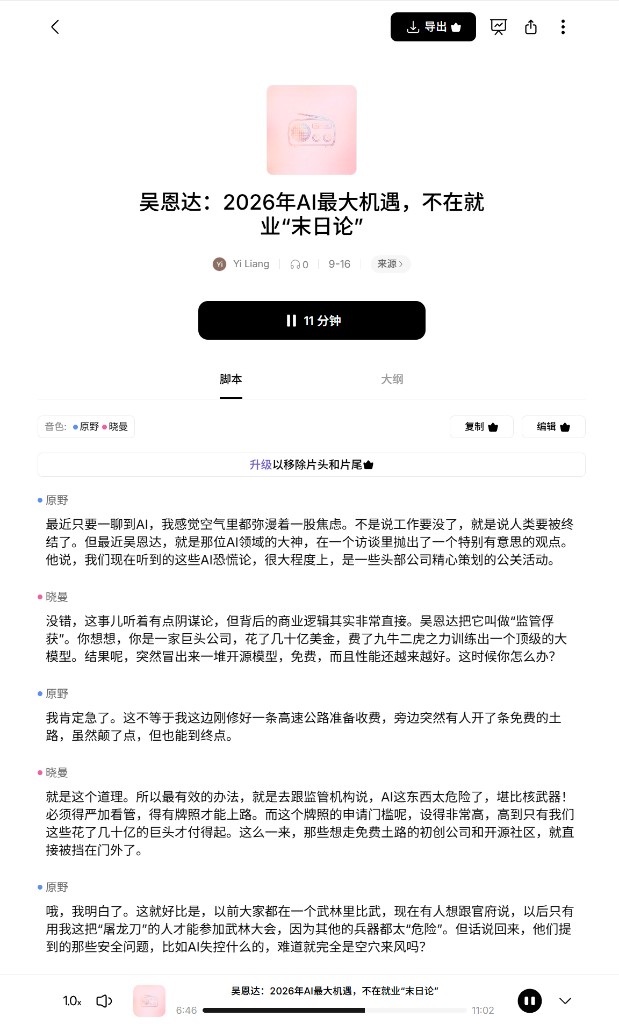
The source I used was Andrew Ng on Silicon Valley Girl: The Biggest Opportunities in AI Aren’t Where You Think. I picked Yuanye (原野) and Xiaoman (晓曼), and got an 11-minute two-host show: 吴恩达:2026年AI最大机遇,不在就业“末日论”.
This is ListenHub’s retelling, not Ng’s original wording.
From YouTube to two voices
1
2
3
4
5
YouTube URL
        ↓
pick two voices
        ↓
episode + visual cards
No script writing on my side. The generated page looks like this:
Visual cards
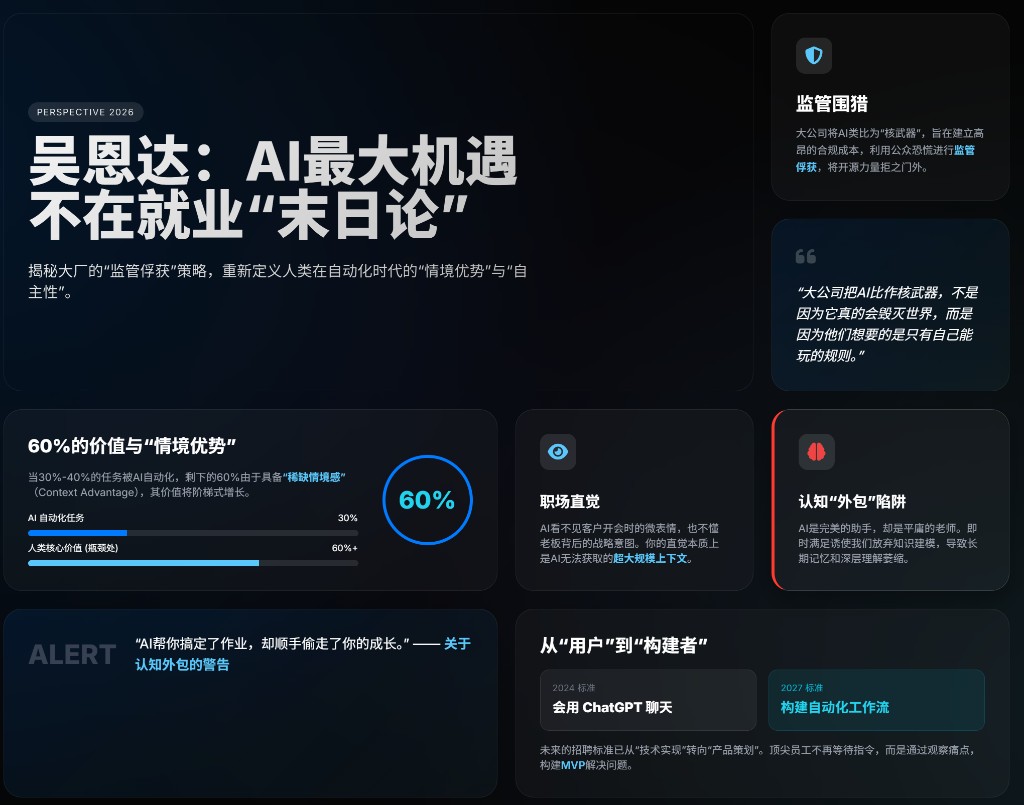
The cards compress the episode into a few beats: regulatory capture, the 60% that stays human, “context advantage,” cognitive outsourcing, and the shift from chatting with AI to building workflows.

The generated script (English)
Yuanye: Lately, whenever AI comes up, the air feels thick with anxiety. Either jobs are about to vanish, or humanity is about to end. But recently Andrew Ng — that well-known figure in AI — made a surprisingly interesting point in an interview. He said a lot of the AI panic we keep hearing is, to a large extent, a carefully planned PR campaign by a handful of leading companies.
Xiaoman: It sounds a bit conspiratorial, but the business logic underneath is actually very direct. Ng calls it “regulatory capture.” Imagine you are a giant company. You spent billions of dollars and a huge amount of effort training a top-tier model. Then a pile of open-source models shows up — free, and getting better all the time. What do you do?
Yuanye: I’d panic. It’s like I just finished a toll highway, and someone opens a free dirt road next door. Bumpy, sure, but it still gets you there.
Xiaoman: Exactly. So the most effective move is to tell regulators: AI is too dangerous — as dangerous as nuclear weapons. It must be tightly controlled. You need a license to get on the road. And the bar for that license is set so high that only the giants who already spent billions can afford it. Startups and the open-source community that wanted the free dirt road are locked out.
Yuanye: Ah. It’s like everyone used to compete in the same martial-arts world, and now someone wants the government to say only people with this Dragon-Slaying Saber can enter the tournament, because every other weapon is too “dangerous.” But still — the safety issues they raise, like AI going out of control — is that completely made up?
Xiaoman: That’s a good question. Ng uses a clever analogy: flying a plane. Even today we cannot perfectly control every gust of air a plane meets. Early planes even crashed. That did not stop us from improving the engineering until flying became very safe. AI is similar. We cannot perfectly control every output. It can make mistakes. That is an engineering problem, and iteration can address it. What the giants do is blow the possibility of “local errors” up into an “existential crisis for humanity.” The line between those two gets blurred.
Yuanye: Interesting. So rather than worrying about being ruled by AI robots, we should maybe worry more about whether a few licensed giants will end up ruling innovation. But honestly, compared with those big themes, ordinary people care about something much more specific: is my job actually safe?
Xiaoman: That leads to Ng’s other core point — and his strongest pushback against “job doomsday.” He says the relationship between AI and people is not simple substitution. It is “economic complementarity.”
Yuanye: Economic complementarity? How should I read that? The version a lot of people hear is: AI can do 40% of your work, so the company can fire 40% of the people?
Xiaoman: The opposite. Ng’s math is: once AI takes the 30% to 40% that is most tedious and repetitive, the remaining 60% to 70% becomes scarcer — so its value shoots up. When calculators showed up, accountants did not lose their jobs. They stopped doing arithmetic by hand and spent more time on harder financial analysis and tax strategy. They became more valuable.
Yuanye: So AI is freeing us from the low-skill grunt work.
Xiaoman: Exactly. And he names a crucial idea: “context advantage.” That is currently humanity’s biggest and most durable moat against AI. AI can generate ten marketing plans in a second, but it will also give you a wildly off-base suggestion, because it cannot see the flicker of doubt on a client’s face in a meeting, and it cannot hear what the boss actually meant this morning by “we have to focus on long-term value.”
Yuanye: I think I get it. What we call “reading the room,” or workplace intuition. AI can process data. It cannot process that subtle, very human context.
Xiaoman: Right. Ng thinks “taste” and “judgment” are basically your ability, built over years, to handle unstructured information AI cannot get. Take this podcast: AI can read a script cleanly, but it cannot feel which line will make listeners smile, or where a pause would build suspense. That sense of timing is context advantage.
Yuanye: So AI is pushing us to sharpen the more advanced skills — the ones closer to art and to the core of decision-making. But to get those skills, you have to learn. Here’s the paradox: Ng actually says that using AI the way people use it now is a disaster for learning.
Xiaoman: That’s his most counterintuitive point — especially coming from someone whose career is built on AI education. His logic is that today’s models are, in essence, a tool for “cognitive outsourcing.”
Yuanye: Cognitive outsourcing? Sounds like a new term.
Xiaoman: Think of it as a chauffeur for your brain. Students who use AI for homework can get high scores, because AI hands them a perfect answer. Studies show their knowledge retention on later exams is very low. They were just moving answers around. The brain never went through the hard work of thinking and building a knowledge system. Ng has an example of his own: six months ago he used AI to solve a coding problem and it felt great. Six months later he hit the same problem, had forgotten everything, and had to ask AI again.
Yuanye: I feel that. It’s like driving with GPS. You take the same route every day, but if the GPS turns off, you still don’t know whether to turn left or right at the next intersection. You outsourced the whole cognitive process of knowing the road.
Xiaoman: That’s the idea. So he says AI is a perfect executor and a terrible teacher. It finishes the task for you — and quietly steals the growth you were supposed to get from doing it.
Yuanye: So what then? Should we ban AI entirely while learning? That doesn’t sound realistic.
Xiaoman: Ng’s answer is not to ban it, but to change how we use it. He put a hundred million dollars into a project called Learn Vector, trying to turn AI from a machine that gives answers into a coach that guides you to think. That shift also leads to his core judgment about the future workplace: the dividing line is no longer whether you “know how to use” AI. It is whether you “know how to build” with AI.
Yuanye: Wait — “build” with AI? That already sounds like a high bar. Ng even said that by 2026 or 2027, when he hires people in marketing, finance, and other non-technical roles, he will expect them to be able to build with AI. For ordinary workers, isn’t that a bit harsh?
Xiaoman: It sounds harsh. It is also just saying the quiet part out loud. It used to take an engineering team to ship software. Now AI has driven the cost of implementation way down. The real bottleneck moved from “how do we build it” to “do you know what to build.” The trait he cares about most in hiring is a sense of agency — a very strong bias toward acting on your own.
Yuanye: What counts as agency?
Xiaoman: For example, a finance colleague on his team was spending hours every week copying and pasting reports. She did not wait for engineers to put it on the roadmap. She used AI tools to write a few simple automation scripts and let the workflow run itself. A marketing colleague built a small desktop app that scraped trending topics and helped him decide which articles would take off. Those people are no longer just AI “users.” They are builders of their own workflows.
Yuanye: Here’s a worry, though. If an accountant spends a lot of time learning to write scripts, won’t that hollow out their actual finance skills?
Xiaoman: That’s the part Ng finds most exciting. Once that finance colleague automated those hours of copy-paste, she did not become less of a specialist. She had more time for deeper analysis and risk warning. AI did not turn her into a programmer. It gave her leverage: it freed her from 30% of repetitive work so she could put 100% of her attention on the 70% that is actually her professional value.
Yuanye: Got it. So the core competitiveness going forward is walking on two legs: domain expertise plus the ability to build. Know the work, and be willing to steer AI to improve the work.
Xiaoman: Exactly. That also ties together the main points we talked about today.
Yuanye: It does. Let’s recap. First, a lot of the fear around AI may be a firewall that a few giants designed to protect their market position. We need our own judgment.
Xiaoman: Second, AI will not simply snatch our jobs. It is more like a catalyst. It strips out the repetitive parts, and that makes the uniquely human “context advantage” — taste and judgment — more valuable.
Yuanye: The key point: in the future workplace, being able to chat with AI is only the passing grade. Being able to build an AI workflow for your own job is the real edge. Competition has already shifted from “can you operate it” to “can you build with it.”
Xiaoman: Right. Going from a passive user to an active builder may be the biggest opportunity of the AI era.
Yuanye: We often ask, “What will AI make us lose?” After hearing Ng’s points, a sharper question sits in my head: are we, because we are afraid of losing something, actively giving up the ability to create and shape the future? The scariest risk may not be AI one day going out of control. It may be that we, surrounded by doomsday talk and the convenience of cognitive outsourcing, slowly give up independent thinking and give up authorship of the future. In an era when the cost of building is almost zero, mediocrity is no longer an excuse of insufficient ability. It is more often a choice. If you are still waiting for a perfect regulation, or a perfect AI how-to guide, before you start, you may already be out of the race. The biggest failure in this era is not being replaced by AI. It is having unprecedented power in your hands — and still choosing, quite comfortably, to stay in the audience.
Takeaways
- Doubao’s AI podcast button still cannot start from a YouTube URL.
- ListenHub can: paste the link, pick voices, wait — and you also get summary cards.
- The episode is a retelling. Useful for a quicker listen; not a substitute for Ng’s original interview.
A small experiment, an 11-minute two-host show, and a set of cards — short try, enough to see how this kind of tool actually sounds.